Article overview
Give hanger manufacturers a brief that answers the right questions
Identify the garment and its use: a jacket on a sales-floor rail, trousers in a stockroom or clothing inside a guest wardrobe. Send a garment photograph and explain handling. A shoulder profile suitable for one garment may be unsuitable for another; describe the actual use rather than requesting a universal hanger.
Give hanger manufacturers the rail dimensions, required hook clearance and any fixture restrictions. Add photographs with measurement points marked. Distinguish an existing model from a proposed change, and name the person authorised to approve that change. A catalogue reference is a useful starting point, but it does not define an unquoted alteration or confirm its feasibility.
Describe the material and garment format without assuming performance
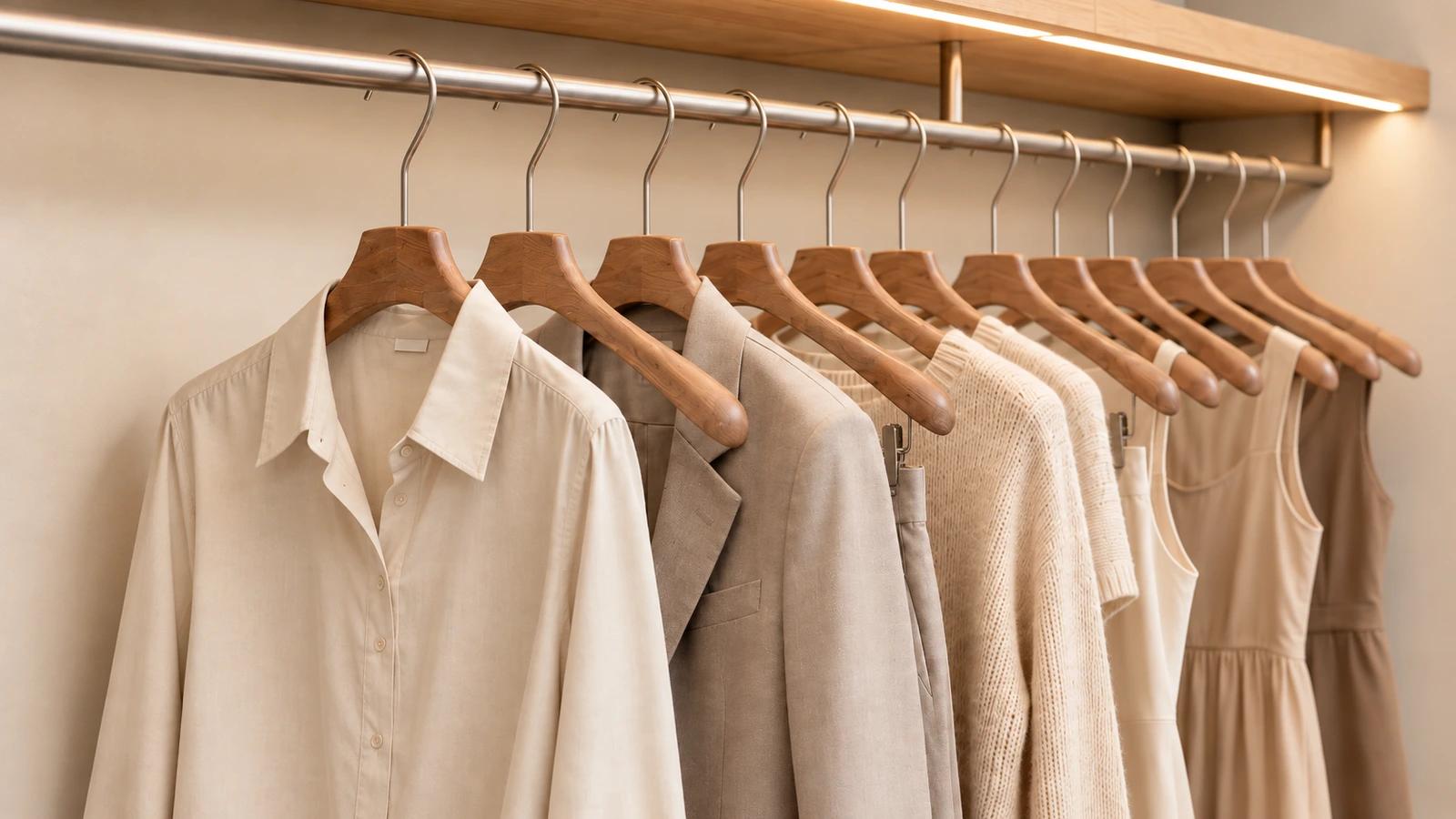
Use the wooden hanger collection to discuss shoulder shape, timber appearance and bar construction. The wide-shoulder wooden product example gives a concrete reference for the conversation; its published configuration is not a specification for every wooden model. If certified material is requested, ask which quoted material and supporting documents apply. A general sustainability statement does not confirm a particular order's FSC claim.
For the velvet collection, state the garment fabric and contact area. Check retention, rubbing and colour transfer on the selected sample with actual garments; black or flocked surfaces do not prove these properties. Identify the shoulder, bar or clip format.
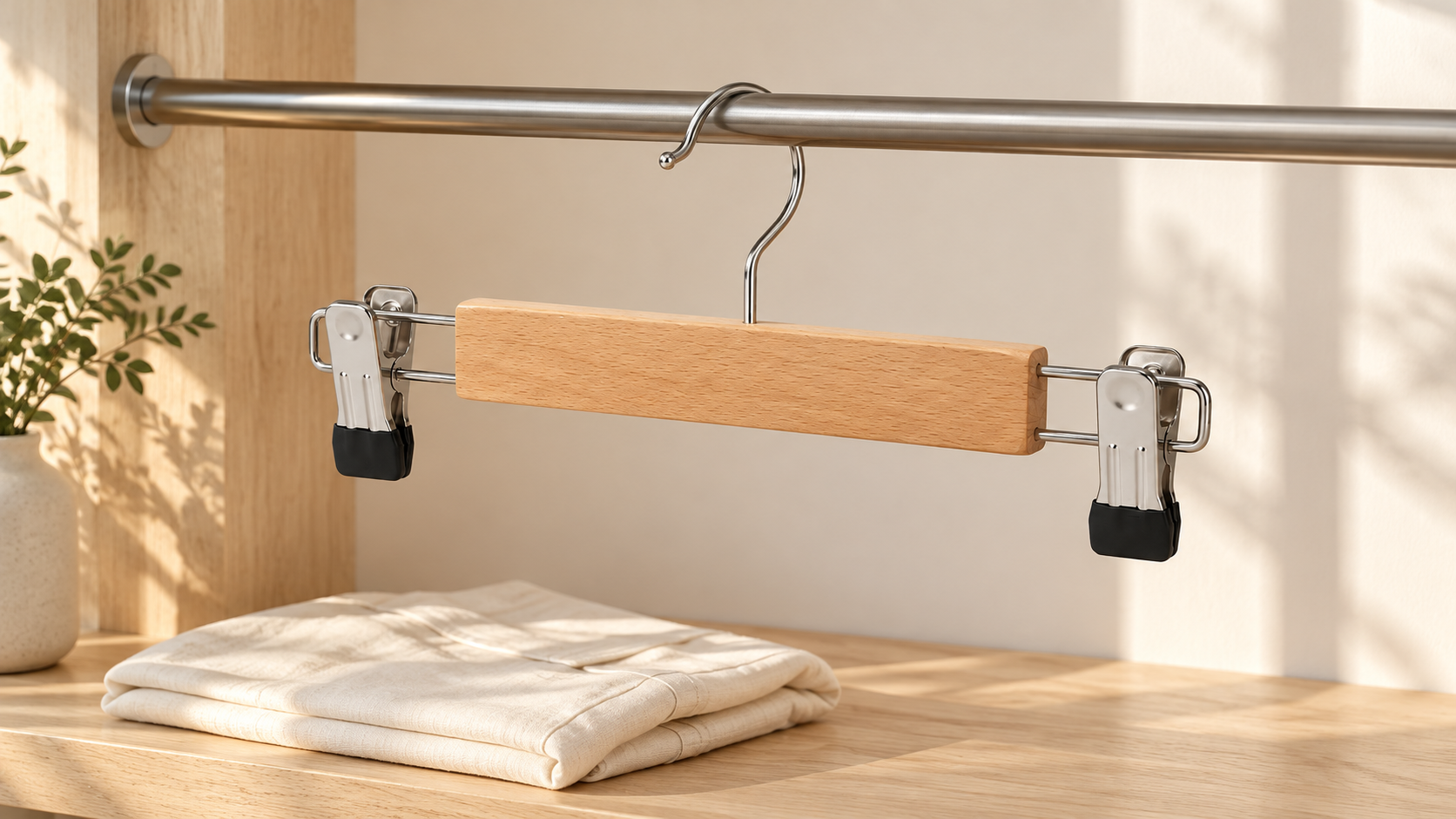
With metal formats, clarify construction, edges, joining points and finish. Inspect contact surfaces and hook alignment, and define the garment trial before approving load suitability. Material families guide the questions; they do not replace model evidence. Record any plastic alternative as a separate configuration instead of assuming a common mould, colour minimum or print process.
Agree measurement points and purchasing units before sampling
Overall width, shoulder thickness, hook clearance and usable bar span are different measurements. Mark each on a drawing or an annotated photograph, include the unit, and specify where it is taken. If a measurement remains open, identify it explicitly rather than copying a dimension from an unrelated model. The hanger measurement guide helps structure the garment-fit check.
Write down whether quantities mean individual pieces, sets or another agreed packing unit. Give each distinct material, finish and construction a clear SKU reference. Otherwise, an attractive unit price can refer to a different counted unit, and a mixed order total may conceal unmet minimums for individual variants. Keep the quote's unit beside its quantity.
Attach a revision identifier to the measurement sheet. Record the method and acceptance criteria; confirm tolerances rather than inventing a universal allowance. The sample and purchase order should reference that same revision. Resolve discrepancies between drawing and sample before authorising production.
Make artwork, colour and sample approval part of the quote
Provide a vector artwork file in AI, EPS, PDF or SVG, alongside logo size, placement and an applicable colour reference. Show where the mark sits relative to the shoulder, bar or another defined feature. A mock-up communicates intent but does not establish whether a technique will work on the selected material and coating.
Use the custom hanger buying guide to frame method selection. Confirm legibility, placement and surface compatibility on a physical sample. Distinguish the colour reference from natural material variation and viewing conditions. Photographs support, rather than replace, the agreed sample.
Ask hanger manufacturers to identify what sampling includes and which changes require another sample. VNEW's sample-manufacturing planning reference is 7–10 days; buyer review and revisions are separate. Confirm the project-specific schedule in the quotation. An approval record should identify the sample, specification revision and accepted exceptions rather than simply stating that the overall appearance looks right.
Compare quote scope, not just the headline unit price
Send the same specification to each recipient. Reconcile responses with this checklist: an empty cell requires clarification, not an assumption that the service is included.
| Specification | Evidence to request | Approval reference |
|---|---|---|
| Material and format | Model description and applicable material documents | Selected SKU and material record |
| Dimensions | Marked drawing and measurement method | Agreed drawing revision |
| Finish and logo | Surface sample and artwork proof | Approved sample and artwork revision |
| Quantities and units | MOQ, price unit and SKU split | Itemised quotation |
| Packing | Protection, counted contents and destination requirements | Packing specification |
| Timeline and delivery scope | Confirmation point, included stages and exclusions | Accepted commercial terms |
For VNEW standard custom programs, 500 pieces per SKU is only a starting reference. The exact model and quotation govern the minimum, including finish, branding and packing conditions. Do not assume a universal plastic minimum or that quantities across different variants can be combined to satisfy one SKU's requirement.
The standard planning reference is a total 25–35 days after specification, sample and commercial confirmation, including manufacture, quality control and packing. Sampling is separate; transport and customs are excluded. Confirm departures from this reference for the actual project. Compare the delivery term, destination and included charges explicitly rather than interpreting a production window as an arrival date.
Resolve exclusions and revisions before accepting the offer
Return a numbered clarification list to hanger manufacturers, linked to the quoted SKU and drawing revision. Identify each accepted item, proposed change and unresolved question. Ask how a change affects cost, sampling or timing, without presuming a fixed response deadline. Consolidating comments prevents an artwork email from silently overriding a technical approval.
Use VNEW's customization program to discuss material, mark and finish. Assign a decision owner to open points and retain written approval against the final quote. Store allocation and repeat-order execution require separate operational records.
Frequently Asked Questions
What MOQ should the quotation specify?
Specify the model, configuration and counted unit. VNEW's standard starting reference is 500 pieces per SKU, subject to the exact quotation. A mixed order total does not replace each variant's minimum.
How should sampling and production time be separated?
Sample manufacture has a 7–10-day planning reference; buyer review is separate. The confirmed standard total of 25–35 days includes manufacture, QC and packing, not sampling, transport or customs. Confirm the project's actual schedule.
Which artwork files should a buyer prepare?
Prepare AI, EPS, PDF or SVG with size, placement and applicable colour reference. Confirm technique compatibility on the selected surface and identify the file revision on the sample approval.
Which material and certification claims need evidence?
Check the material of the quoted model and applicable supporting documents. A general FSC statement does not certify every order. Verify garment contact and load suitability on the selected sample.
How can offers be compared beyond unit price?
Use the same specification revision. Compare quantity units, finish, branding, packing, timing, delivery terms and exclusions. Resolve missing entries and record the accepted offer before ordering.
Send your marked specification, artwork and quantity breakdown to request an itemised hanger quotation, with the required packing and delivery scope identified.
Buyer path
Continue from guidance to a working specification
Compare hanger options, define quantities by model and finish, then prepare the specifications needed for a quotation.
Share this story
Save or forward this article to your sourcing and merchandising team.