Article overview
Start a velvet hanger wholesale checklist with store demand
Count displayed garments by store, department and season, separating working stock from reserves. A retail pack of 50 or 100 pieces describes a sales unit, not factory MOQ or agreed carton quantity. Allocate each configuration separately.
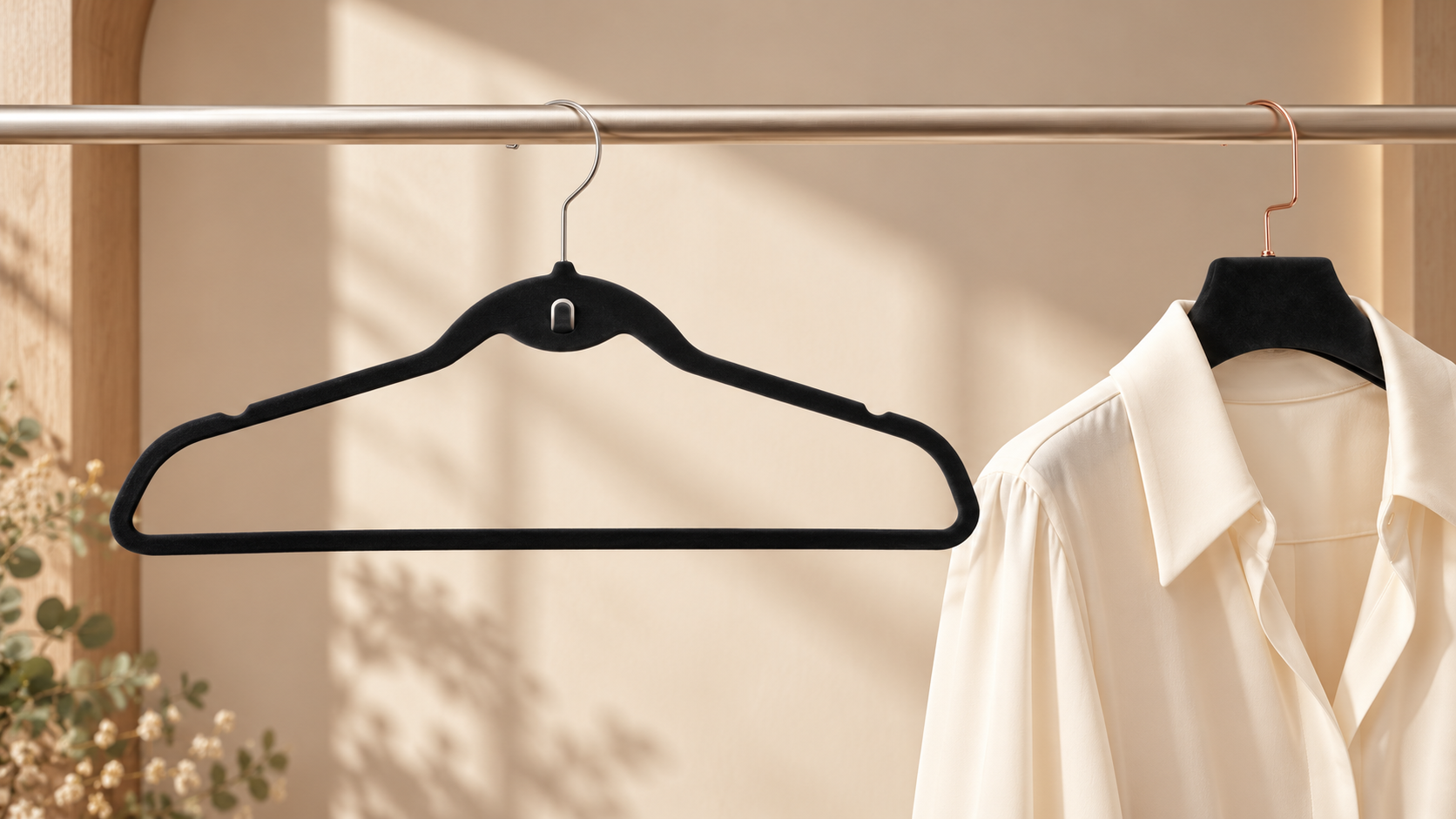
Black flocked top hanger with shoulder notches (SKU 1600238844605): use this specific format to check shoulder fit and strap position with your garments. Review the model's published specification and confirm its own minimum order, colour and packing in the quotation; a general custom-programme reference does not apply automatically to every SKU.
Start your velvet hanger wholesale checklist with the VNEW velvet collection. Check rail density with garments attached before multiplying demand across stores.
Trial flocking and garment contact before store rollout
Agree trial conditions with the supplier using representative fabrics, knitwear and frequently handled garments. Check grip, shedding, colour transfer and shoulder pressure. Five garments over 24 hours can be a discussion example, not an industry standard or a completed VNEW test.
Record observations by garment and sample, photographing marks and contact points. The velvet bulk sourcing guide develops sample and batch checks before store distribution.
Approve profile, notches, bar and hook as one configuration
Measure width and thickness; check shoulders, notches and bar together. Market descriptions such as 42–43 cm, a 360-degree hook or a 5 kg target need verification, not adoption as VNEW specifications. Test hook movement and garment removal on the intended rail.
Use the hanger measurement guide for measurement points and the velvet style selection guide to distinguish shoulder, bar and clip use. Approve each combination separately.
Keep colour and branding repeatable across stores
Examine a physical colour reference under store, daylight and office lighting. Record the date, variant and approver; photographs support but do not replace the sample.
Define logo size, position and artwork version through the custom specification programme. Confirm surface compatibility and approve the finished mark with its colour and hardware, not separate photographs.
Compare the same variant and calendar in each quotation
Use the velvet hanger wholesale checklist to request comparable quotations by body material, profile, flocking colour, hook, logo and packing. VNEW's standard-project starting reference is 500 units per SKU, with the final minimum confirmed for the actual configuration and order. Do not combine different colours into a total and assume that every variant meets its quoted minimum.
Separate sample manufacture from buyer approval. The 7–10-day sample preparation reference does not impose a buyer sign-off deadline. After samples, specifications and commercial conditions are approved, the standard total reference is 25–35 days including manufacturing, QC and packing, not freight or customs. Revisions and project conditions can change the agreed calendar; confirm it in the quotation.
The comparison below preserves specification topics, not model-specific performance guarantees.
| Decision point | Best use case | Specification or evidence to confirm |
|---|---|---|
| Non-slip velvet surface | blouses, dresses, knitwear, and light jackets on densely stocked retail rails | A non-slip velvet surface should support garments without shedding, abrasion, or pressure marks. Buyers should test at least 3 fabric types and check the color under store lighting, daylight, and office lighting. |
| Space-saving profile | 50-100 piece sets, store outfitting, and assortments with many SKUs | A slim profile can save rail space, but it must not compromise the garment shoulder line. For B2B programs, record width, profile thickness, carton quantity, and rail density before sample approval. |
| Shoulder notches and trouser bar | dresses, tops, skirts, trousers, and coordinated outfit presentation | Shoulder notches support straps and delicate dresses, while a trouser bar or clips can serve additional garment categories. Test the choice on the intended garment, not only on an empty hanger. |
| 360-degree hook and metal finish | stores, showrooms, and hotel wardrobes with frequent handling | Hook angle, rotation, and finish affect use and brand presentation. Review hook color, plating, movement and carton protection on the selected sample. The 7–10-day reference covers sample manufacture before buyer approval, not the buyer's approval deadline; revisions and the project quotation govern the calendar. |
| 42-43 cm size and 5 kg load target | standard adult formats for retail and hospitality | Many velvet hangers on the market use 42-43 cm widths and quote load figures such as 5 kg. B2B buyers should treat these as test targets and check them with real jackets, dresses, and trousers, not assume a verified load rating. |
| MOQ by color and SKU | seasonal colors, brand colors, and multi-stage store rollouts | VNEW normally plans standard velvet programs from 500 units per SKU (starting reference; final MOQ depends on material, finish, logo method, SKU split, packaging, and destination). Review MOQ separately by color, hook finish, logo method, and packaging. |
| Carton and reorder control | export, repeat orders, and consistent retail presentation | The carton must protect flocking, hook finish, and color. Any 3–5-day QC and packing sub-reference is conditional and included within the standard 25–35-day total after sample, specification and commercial approval, not added to it. Confirm photographs, carton rules and reorder references before shipment; freight and customs are separate. |
Pack by SKU and store without compressing the flocking
Define inner protection, hook orientation, stacking, carton quantity and labels on the packed sample. A retail-pack arrangement is not automatically suitable for export or multi-store receiving.
Identify variants and store allocations clearly. At receiving, compare labels, counts and condition against the packing record before mixing stock. Packing checks do not guarantee freedom from abrasion or pressure marks.
Retain the approved reference for the next store order
Keep one controlled record: master sample, colour, hook finish, logo proof, packing photograph and reorder owner, alongside variants and inspection criteria. Identify changes requiring renewed approval.
Review actual store shortages, garment fit and handling problems. Reference the approved configuration and explicit changes, not a new screenshot or an undefined request for “black velvet”.
Frequently Asked Questions
How should buyers confirm the minimum order for store rollout?
Use 500 units per SKU as a standard-project starting reference, not a universal minimum. Confirm the final quantity for each colour, profile, hook, branding and packing configuration in the quotation.
When does the production calendar begin?
The 7–10-day reference covers sample manufacture, with buyer review and revisions separate. After sample, specification and commercial approval, the conditional 25–35-day total includes manufacturing, QC and packing, excluding freight and customs. The quotation governs.
Which logo files and references should purchasing teams retain?
Provide AI, EPS, PDF or SVG artwork with dimensions and placement. Retain the approved version, colour and finished sample. Confirm branding compatibility on the chosen surface.
What material and quality documentation should velvet hanger buyers request?
Request the agreed body material, flocking and adhesive specification, color reference, and sample records for shedding, color transfer, hook movement and garment grip. Agree the checks and acceptance criteria before production. Do not treat an unrelated factory certificate as a test report or a guarantee for the finished hanger.
What should be checked before a repeat store order?
Check variants, colour, hook, logo and carton against the approved record. Confirm whether changed garments or store allocations need new samples; compare prices on equivalent quantities and conditions.
Send your velvet hanger wholesale checklist, variant quantities and store plan through VNEW's procurement contact. Confirm sample checks and the quotation before scheduling rollout.
Buyer path
Continue from guidance to a working specification
Compare hanger options, define quantities by model and finish, then prepare the specifications needed for a quotation.
Share this story
Save or forward this article to your sourcing and merchandising team.