Article overview
Start with the garment and its hanging method
Record the display method: a top alone, with folded trousers, or separately hung coordinating pieces. Identify narrow straps, broad necklines, structured shoulders or a waistband intended for clips. A photograph cannot answer these fit questions for your range.
Separate display requirements from purchasing assumptions. A coordinated outfit does not necessarily need one hanger; the garment team must accept any folding point. Use the same garment examples across showroom and store teams, so a silhouette approval is not confused with a different hanging method.
Compare velvet hanger styles by structure
The useful distinction between velvet hanger styles is the underlying format and where the garment touches it. The table below is a selection aid based on four recorded VNEW model descriptions, not a performance ranking. Confirm the actual configuration of each sample rather than treating every product in the material category as interchangeable.
| Format | Garment contact | Question for the sample |
|---|---|---|
| Top-only flocked form | Shaped shoulders, outer notches and rounded ends | Does the top rest at the intended shoulder and strap positions? |
| Continuous trouser-bar form | Shoulders and a lower bar for a folded garment | Is the fold acceptable, with enough clearance for the outfit? |
| Shoulder form and separate clip form | Shoulder support or two clip contact points | Which configuration is needed, and where do the clips meet the garment? |
| Partially flocked wooden form | Exposed wooden centre, covered shoulder ends and lower bar | Do coverage transitions suit the garment and the intended appearance? |
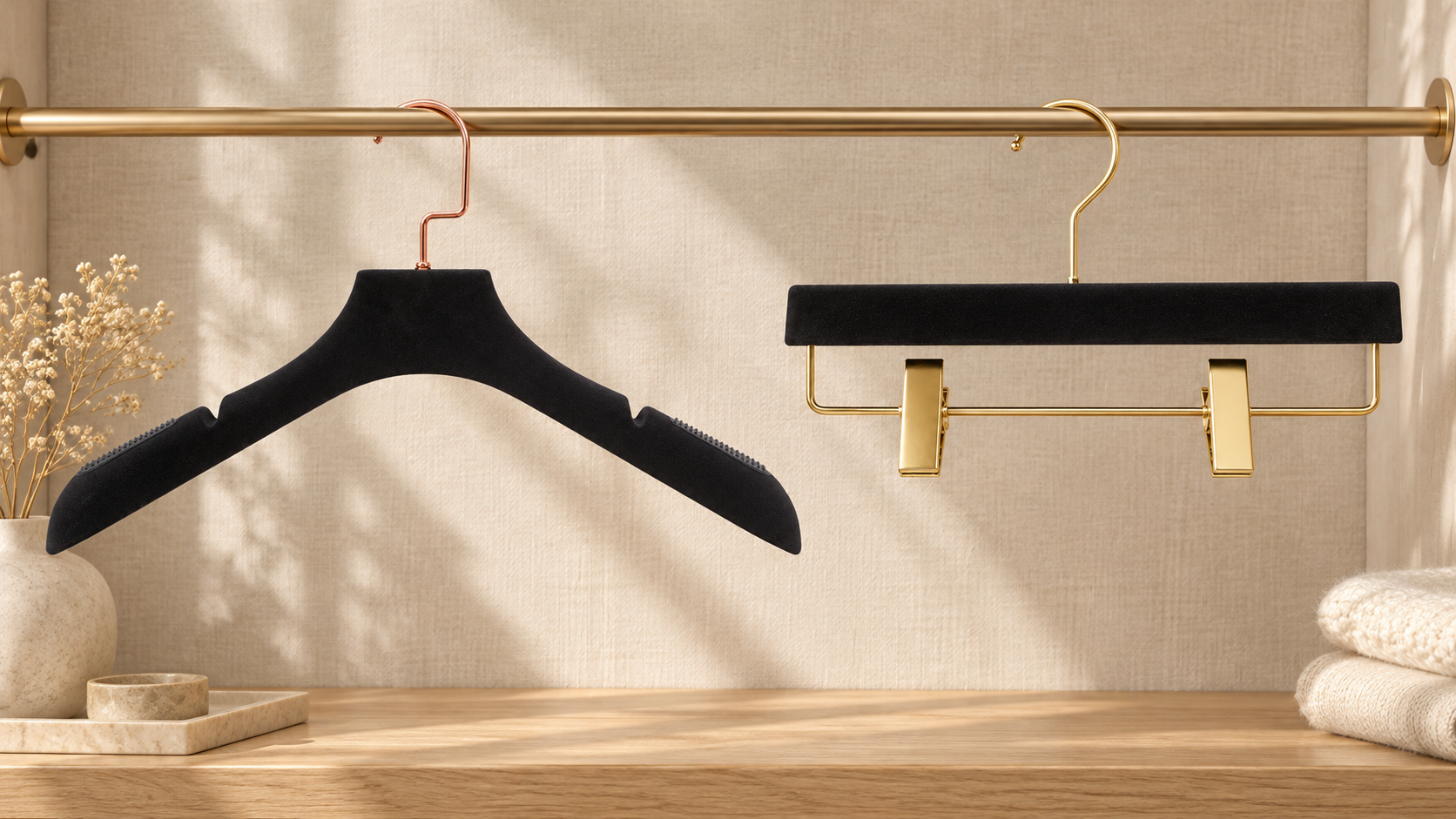
The black flocked top-only model has an open underside rather than a trouser bar. The bar model with a neck attachment has shallow shoulder notches and a continuous lower bar. Its attachment is a visible feature, not proof of a tested chain of loaded hangers or a quantified space saving.
Shoulders, straps and neck clearance
Place the intended top on each sample and compare the shoulder ends with its construction. Check the neckline during both placement and removal. A narrow opening and broad profile may require different handling; a front-view photograph does not show that interaction.
Compare notch location with the strap's natural position and record any sideways pull. For a blouse without straps, the notch may be irrelevant. Use the same garments across candidates and photograph their contact points; changing both garment and hanger obscures the comparison.
Our garment-fit and hanger measurement guide helps define measurement points. Do not transfer a width or fit decision from another model merely because its outline looks similar.
A trouser bar or a separate clip hanger?
A continuous bar is a candidate when folded presentation is acceptable. Compare where the fold lands, whether the top obscures the trousers, and how the garment can be removed without disrupting the outfit. The bar and shoulders form one configuration, so clearance needs checking with both garments together.
The black shoulder and separate clip formats provide a different comparison: a shoulder form for tops and a straight two-clip form for bottoms. Specify each required configuration. A photograph showing both does not establish bundled supply, adjustable clips or mark-free contact.
Identify the intended gripping area and inspect the garment after proposed store handling. Confirm clip construction rather than assuming it moves along the rail. If pieces are priced or ordered independently, keep their model references separate in the sample request.
Surface coverage, colour and a coordinated rail
Compare velvet hanger styles by coverage as well as silhouette. The wooden model with brown flocked areas exposes a natural wooden centre, with covered shoulder ends and lower bar. Its shoulder notch sits within a covered section. This differs visibly from a covered plastic-bodied form; the recorded wood description does not identify a species.
Check which surface touches the garment, including the boundary between exposed wood and the covered area. Flocking is a construction detail, not evidence that every textile will stay in place or remain unmarked. Ask separately about an unspecified bar covering rather than assigning it a material from its colour.
View shortlisted samples together under the intended retail lighting. Compare hook tone, surface colour and profile from the customer's viewing position. Confirm finish and hardware by model; matching photographs do not prove identical materials, shared dimensions or a common pack quantity.
Turn the choice into a focused sample request
Request velvet hanger styles against a short model-selection note: garment examples, hanging method, shoulder or clip contact, target dimensions to confirm, and colour or hardware reference. State what each candidate must resolve. For example, compare a folded-trouser arrangement with a separately clipped bottom, rather than requesting every available colour before choosing the structure.
Keep an alternative only when it answers a different fit question. Once the format is selected, use the bulk-order and flocking assessment guide for the next purchasing stage. Minimum quantity, branding, packing and timing require model-specific confirmation; they are not established by this selection exercise.
Frequently Asked Questions
Are all velvet hangers built on the same core?
No. The models discussed include recorded plastic-bodied forms and a wooden form with partial flocking. The material category alone does not establish the core or covering of every listing. Confirm the selected model's construction rather than transferring another product's description.
When should a top hanger have a trouser bar?
Consider a bar when the outfit should be presented together and the bottom garment can be folded as intended. Compare the fold position and clearance on an actual sample. A top-only arrangement may be preferable when the lower garment is displayed separately.
Can notches replace a clip hanger for every garment?
No. Shoulder notches and clips contact different parts of a garment. Compare strap position on a top with the intended clip area on a skirt or trouser. Neither feature establishes suitability without trying the relevant garment.
Does a matching top and clip photograph mean a supplied set?
No. It shows related appearances, not the agreed order configuration. Confirm each model, whether the forms are supplied together, and their individual materials and hardware. Visible brand marks also do not establish permission to reproduce that logo.
Which styles should a retail buyer request as samples?
Shortlist formats against the garments: top-only, a bar for folded presentation, a separate clip form, or partial coverage where relevant. Attach the garment reference and the question each sample must answer. Avoid selecting every finish before the structure is settled.
Share your garment references and shortlisted velvet hanger styles with VNEW's product selection team. Confirm the model configuration before turning a visual preference into a purchasing specification.
Buyer path
Continue from guidance to a working specification
Compare hanger options, define quantities by model and finish, then prepare the specifications needed for a quotation.
Share this story
Save or forward this article to your sourcing and merchandising team.