Article overview
Specify Velvet Clothes Hangers in Bulk by Model
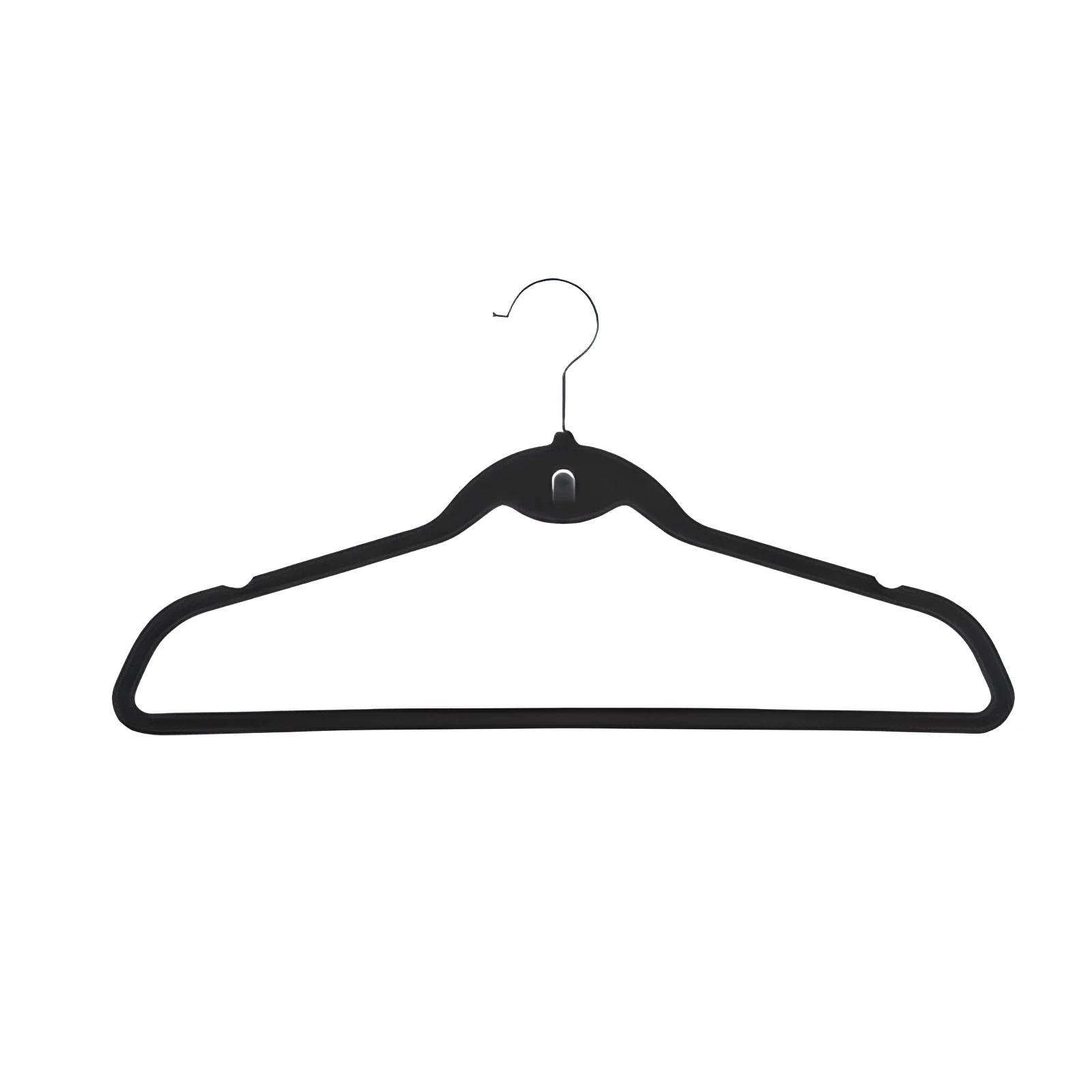
Separate body, flocking and hardware. Confirm the model and sample against the quotation. The cover shows the named model; its appearance is not proof of surface performance or loaded cascading capability.
VNEW’s black flocked model with trouser bar and neck attachment, SKU 1601025619187, lists ABS plastic, velvet and metal, dimensions of 44.5 × 23 × 0.5 cm, a 500-piece MOQ and a 200-piece carton reference. These are model-specific records, not collection-wide terms. Confirm the measurement points, packing arrangement and current quotation. A neck attachment does not by itself prove that an assembled cascading arrangement can support your intended garments.
When comparing velvet clothes hangers in bulk, keep the same body and hardware in each quotation. Record quantities by SKU and colour; do not infer a per-colour minimum from the model’s general MOQ.
Agree Fabric-Contact and Flocking Checks
Use garments from the intended assortment, especially fabrics whose appearance or handling makes surface contact important. Identify the shoulder, neckline and trouser-bar contact areas. Agree how samples will be loaded, removed and inspected, including any handling or cleaning method relevant to the buyer’s operation. This is a proposed acceptance process, not a claim that the product has passed a universal test.
Record observations of loose fibres, visible colour transfer, exposed patches or an uneven surface under the agreed conditions. Ask the supplier to review unacceptable observations and submit a revised sample where necessary. A soft feel alone cannot establish grip, colourfastness or durability. Keep photographs with the garment and sample reference, rather than an isolated close-up that hides where contact occurred.
| Contact or handling point | Buyer-agreed sample check | Record for batch approval |
|---|---|---|
| Shoulder and neckline | Place and remove representative garments | Fabric reference and contact observations |
| Trouser bar | Check the intended folded garment | Fold position and surface observations |
| Flocked finish | Review loose fibres and visible transfer | Agreed method and acceptance decision |
| Colour and logo | Compare the completed sample in intended lighting | Colour reference and artwork version |
| Packed neighbouring bodies | Inspect the agreed packing arrangement | Contact protection and carton specification |
Define what requires a revision and who can approve it; agree methods rather than inventing a universal rubbing standard.
Compare Profile, Notches and Rail Spacing
Assess the complete garment-and-hanger combination on the intended rail. Shoulder width, curvature and the location of contact points matter together: an acceptable overall width can still leave an unsuitable shoulder transition. Follow the hanger measurement and garment-fit guide to identify measurement points, then confirm the selected configuration against actual clothing.
Check strap placement where notches are specified, the clearance around the neckline, and whether a folded garment conflicts with the body or nearby hardware. Avoid assuming that a feature visible in another collection is available on this model. For a cascading or other connected arrangement, request confirmation of compatible components and an agreed loaded-sample check; do not derive a combined load limit from a single-body record.
For velvet clothes hangers in bulk, evaluate presentation with the proposed assortment and rail spacing rather than a single empty hanger. If the store later changes garment thickness, layout or connected components, review the sample again.
Approve Colour and Branding on the Finished Sample
Compare the finished surface with the selected colour reference under the lighting relevant to the store or wardrobe. Flock direction and viewing angle can change its apparent shade. Note the sample’s orientation and the agreed comparison conditions, so a photographic difference is not mistaken for a confirmed colour defect. Screens are useful for discussion, but the retained physical sample should control approval.
SKU 1601025619187 lists black, white, navy and custom colours, plus an embossed-logo option. Confirm availability and feasibility for the requested configuration; those entries do not establish an unrestricted technique for every flocked hanger. Use the model-based logo approval guide to distinguish artwork approval from approval of the actual mark.
Review logo position with clothing in place, check legibility on the finished surface, and record artwork dimensions and revision. Agree how visible finish variation will be judged before production. A digital logo mockup cannot show the relief or contact behaviour of the final sample.
Protect the Surface in Packing and Reorders
Inspect how hooks, bars and neighbouring bodies touch inside the proposed carton. Ask which separation or protection is included, and confirm whether the quoted packing unit matches receiving requirements. The model’s 200-piece carton reference is not evidence that every alternative arrangement provides identical protection. Confirm any requested inner packaging, labelling or assortment change in the quotation.
For repeat purchases of velvet clothes hangers in bulk, retain the approved model, colour, artwork, sample version and packing specification under one order reference. Compare a new batch with that reference using the same agreed observations. Changed garments or warehouse handling may justify new checks even if the product code remains unchanged.
Frequently Asked Questions
How can a buyer check flock shedding and colour transfer?
Agree a sample-handling method using the intended fabrics, loading and removal conditions. Record visible fibres or transfer with the sample reference. Define acceptance criteria with the supplier; this guide supplies a purchasing checklist, not a tested performance rating or universal rubbing standard.
Why should the base material be confirmed for a flocked hanger?
The surface description does not identify the structural body or hardware. Confirm material, measurement points and construction for the selected model before comparing offers. A similar-looking product can differ underneath the flocking, so its dimensions and quoted terms should not be assumed interchangeable.
How should colour be approved under different display lighting?
Compare a finished physical sample with the colour reference under the intended lighting. Record orientation and viewing conditions, and retain the approved sample. Agree how variations will be assessed; neither a screen image nor an unspecified lighting comparison provides a repeatable approval record.
Can a logo method be assumed to work on every flocked surface?
No. Confirm the published options for the model, then approve position, legibility and finish on its actual surface. SKU 1601025619187 lists an embossed logo, but that does not establish suitability for every artwork or other flocked construction. Ask for a representative marked sample.
What packing details help protect the approved surface?
Confirm the carton quantity, arrangement of bodies and hooks, and any agreed separation or inner packaging. Review a packed sample for unwanted contact. Record labels and assortment requirements alongside protection, so a reorder does not preserve the colour while silently changing the packing configuration.
Review a Surface and Packing Brief with VNEW
Compare the VNEW velvet collection against your garment and display requirements. Send a model-specific sample brief with quantities, colour references, artwork and proposed packing. The next step is an agreed sample and quotation, not a performance assumption based on a photograph.
Buyer path
Continue from guidance to a working specification
Compare hanger options, define quantities by model and finish, then prepare the specifications needed for a quotation.
Share this story
Save or forward this article to your sourcing and merchandising team.