Article overview
Specify Luxury Retail Hangers Around the Actual Garment
Start with the garment group. Separate jackets, coats, shirts, dresses, knitwear and trousers when support requirements differ. Record shoulder construction, collar opening, weight and hanging method. Check the garment on the intended rail: shoulder contact should not extend into the sleeve, the neck must pass through the opening appropriately, and the hook needs fixture clearance. Record concerns rather than assuming a material prevents marks or slipping.
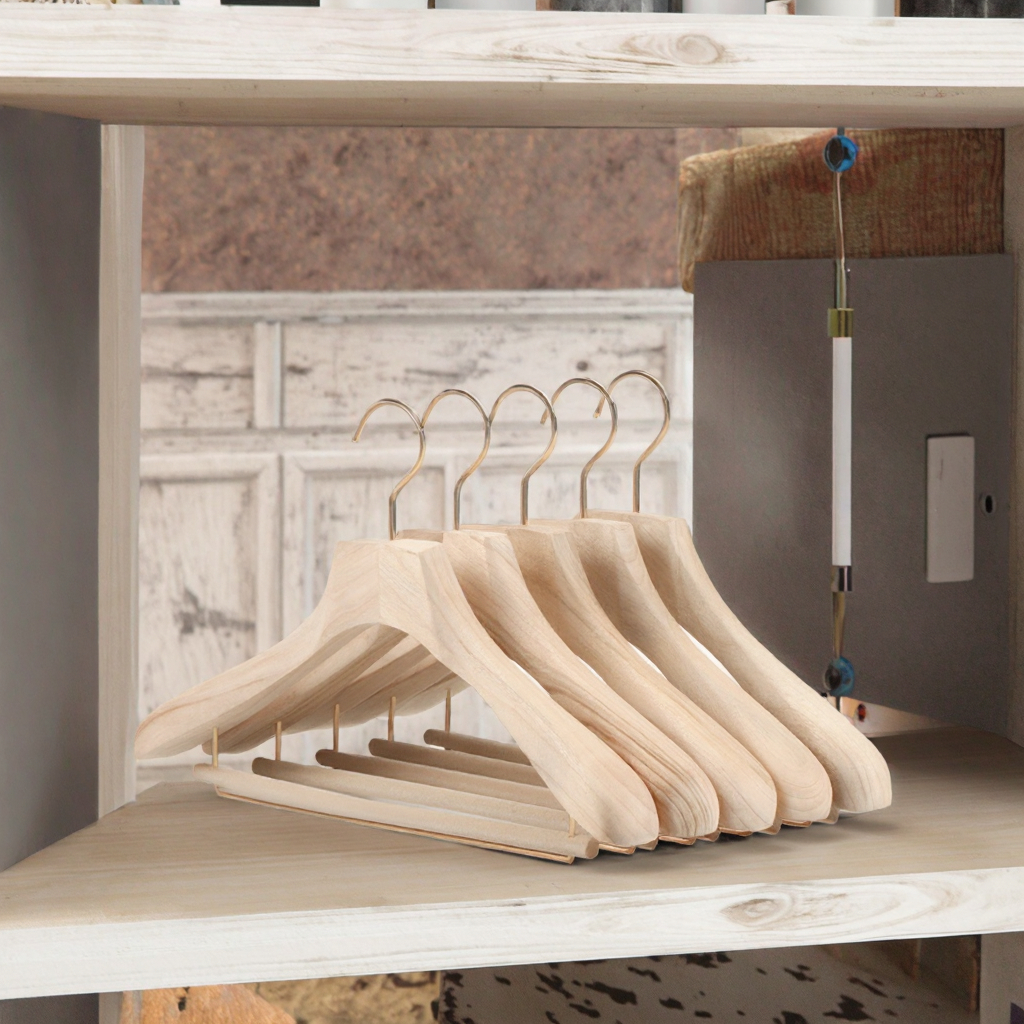
VNEW's wide-shoulder wooden suit hanger formats list length options of 38, 42 and 45 cm. The separate shoulder field lists 3, 5 and 8 cm; these are not alternative overall lengths. Request a drawing showing the measurement points before choosing a combination. Use the hanger size guide to organise the garment and sample measurements. Do not turn the largest listed format into a default for every jacket.
Compare Wood, Velvet and Metal on the Same Rail
Compare candidates with the same garments, rail and handling routine. Luxury retail hangers should be selected for a documented job, not simply because one material looks more expensive. The wooden series records solid hardwood; inspect shoulder contact, the surface and the agreed range of wood appearance. That material entry alone does not establish a particular species or FSC certification for the offered variant. Request evidence for any certification claim you need.
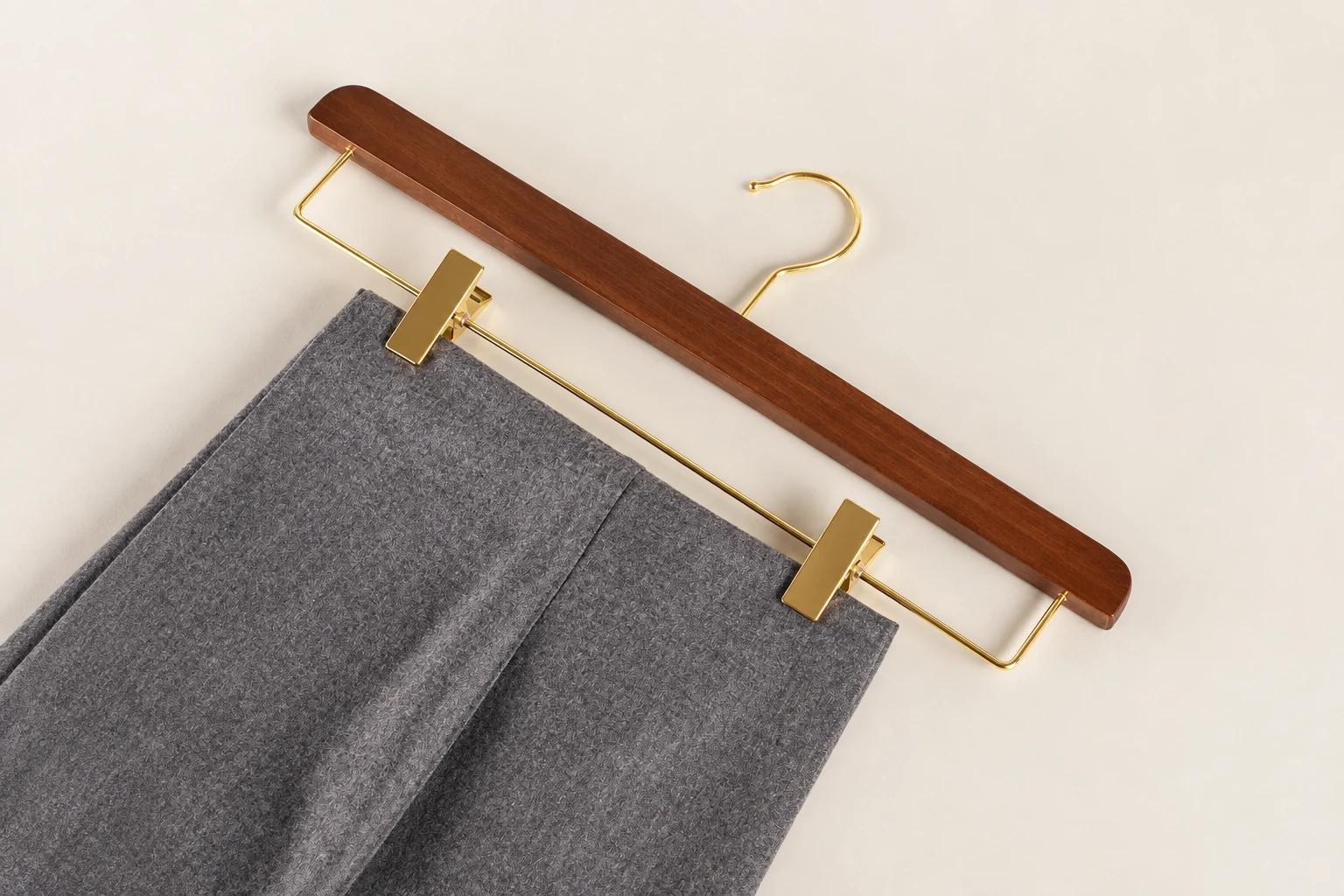
The black flocked hanger with trouser bar and neck attachment records ABS plastic, velvet and metal, with dimensions of 44.5 × 23 × 0.5 cm. Check flock coverage, shedding or colour transfer and the actual garment contact areas using an agreed sample method. The gold-tone metal hanger with shoulder notches records a 40 cm length and 3.0 mm diameter. Inspect its contour, edges and hook fit; a gold-tone finish does not establish the metal grade or a corrosion rating.
| Decision | Sample check | Approval record |
|---|---|---|
| Shoulder support | Hang the representative garment and inspect contact | Garment reference and measurement drawing |
| Rail density | Compare the same garment mix on the same fixture | Arrangement photograph and spacing reference |
| Wood appearance | Compare samples under the intended lighting | Physical finish reference and accepted variation |
| Flocked contact | Check coverage and garment contact by the agreed method | Method, observations and acceptance criteria |
| Metal profile | Inspect edges, contour and hook clearance | Model drawing and recorded concerns |
| Arrival protection | Review how hooks and surfaces are separated | Approved inner packing and carton configuration |
Turn Brand Direction into Measurable Finish Checks
“Quiet luxury”, matte black, warm wood and champagne gold are design directions, not complete production specifications. For luxury retail hangers, translate each direction into a physical finish reference, the accepted appearance range and a defined viewing condition. Photograph several samples together under store lighting, but retain the approved physical reference: a screen image cannot settle every colour or gloss disagreement.
Define the logo's dimensions, position and viewing distance before selecting a process. The wooden series lists laser engraving, hot stamping and screen printing; the flocked model lists embossed branding, while the metal model lists laser engraving. These are model records, not a promise that every technique suits every finish. Use the custom hanger buying guide to prepare the configuration. Ask for the chosen application on a physical sample, and agree its appearance alongside the hook and surface rather than approving three separate photographs.
Approve a Pilot Rail Under Store Lighting
Build a small trial display with the real collection before releasing a multi-store specification. Keep the garment group, fixture and lighting constant when changing the hanger candidate. View the arrangement from the customer's usual position and repeat the staff's normal removal and replacement actions. Look for changes in garment position, shoulder contact, hook clearance and the visible relationship between neighbouring finishes.
Agree the observation period, load and acceptance criteria; an arbitrary 24-hour check is not a universal test standard. Record methods and observations, without presenting the trial as laboratory certification. Identify whether a failure concerns shoulder profile, hanging method, fixture clearance or finish. Retain the approved sample, photographs and configuration reference for future comparisons.
Record the Specification Before Rollout and Reorders
Give each supplier the same quantity breakdown by model, colour and store allocation. The flocked example currently records an MOQ of 500 pieces and 200 pieces per carton; the metal example records 2,000 pieces per colour and 100 pieces per carton. The wooden series does not provide an MOQ in this record, so request it in the quotation. These are individual model references, not one minimum for the whole range; confirm the final configuration, packing and supply terms.
Keep the signed sample, dimension sheet, finish references, logo file, inner packing, carton marks and approval owner in one revision-controlled file. Compare quotations only when those assumptions match. Sampling has a conditional planning reference of 7–10 days, separately from a standard 25–35-day total window after sample, specification and commercial approval. That total includes manufacturing, QC and packing, but excludes transport and customs; the confirmed project schedule takes precedence. Recheck garment fit if a later collection changes its weight or shoulder construction.
Frequently Asked Questions
Should one hanger width cover the whole collection?
Not automatically. Group garments by shoulder and hanging requirements, then approve the relevant samples. A width suitable for a structured jacket may extend into a smaller garment; check the actual collection.
How can buyers compare display density fairly?
Use the same garment mix, fixture and arrangement for each candidate. Record spacing and a photograph from the same viewing position. This separates the effect of the hanger profile from changes caused by different garments or a different display layout.
Can different hanger materials share a consistent store look?
They can be coordinated through approved colour, hook and logo references, but identical appearance across wood, flocking and plated metal should not be assumed. Compare physical samples together under the store's lighting and record acceptable differences before rollout.
What should a pilot rail approval record contain?
Include the garment references, hanger configuration, fixture, lighting, agreed handling method, observations, photographs and approval owner. Keep the physical reference sample with the specification version so a replacement or reorder can be compared with the same baseline.
Is there one minimum order for every luxury hanger model?
No. The examples have different model-level purchasing references, and the wooden record requires an MOQ quotation. Ask for the minimum by model and colour, together with the final packing and branding configuration, rather than applying one number to the total order.
To discuss luxury retail hangers for your collection, send VNEW your sourcing brief with the garment group, configuration references, quantities by model and colour, store allocation, destination and target date. That gives the sampling review a concrete starting point without inventing a universal specification or delivery promise.
Buyer path
Continue from guidance to a working specification
Compare hanger options, define quantities by model and finish, then prepare the specifications needed for a quotation.
Share this story
Save or forward this article to your sourcing and merchandising team.